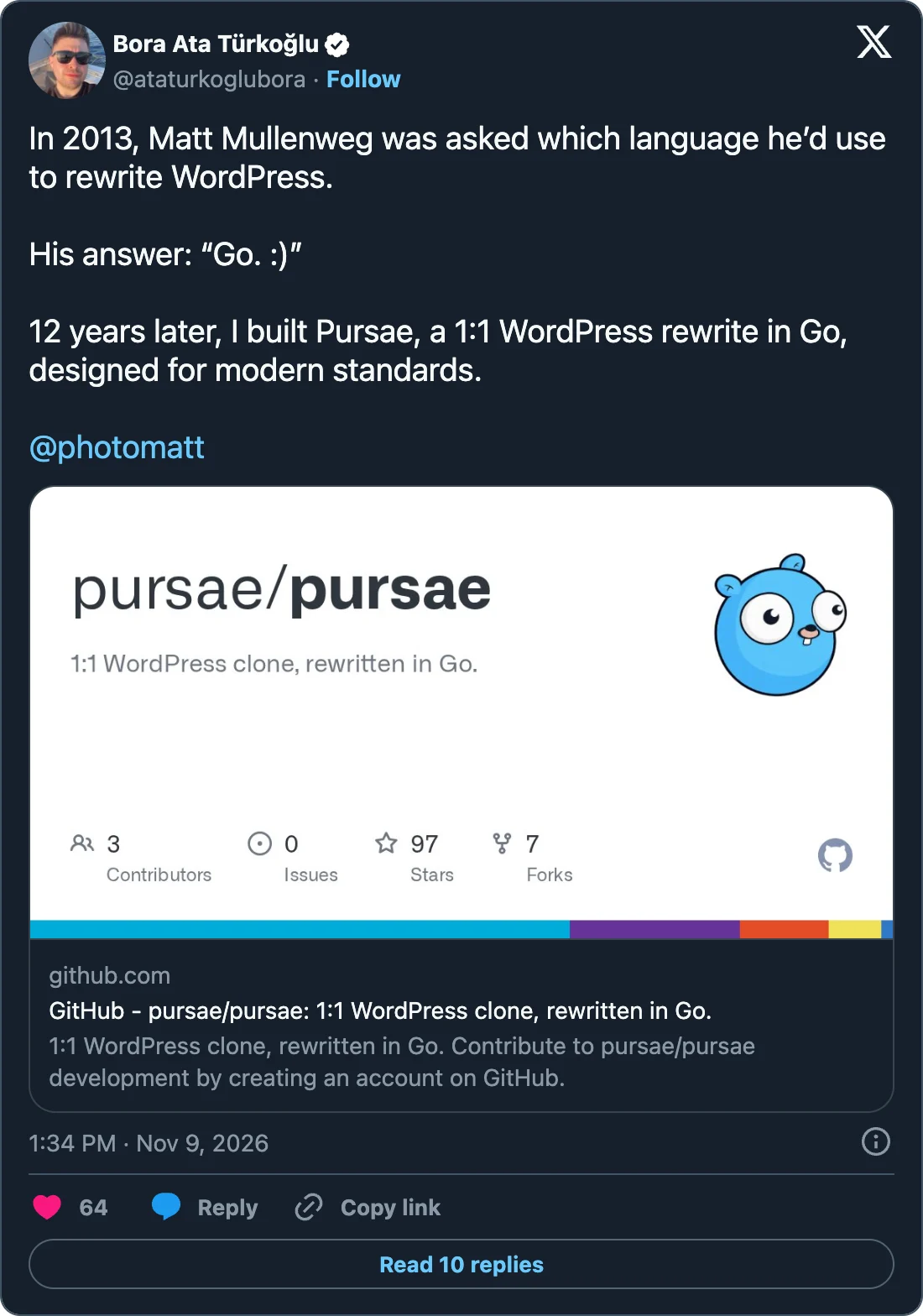
In 2013 someone asked Matt Mullenweg which language he would use if he rewrote WordPress. His answer was two letters and a smiley: “Go. :)”
Twelve years later I took him at his word. Pursae is WordPress in Go, rewritten from scratch. The admin, the block editor and the REST API are the ones you know. Underneath there is no PHP at all.
I posted it on X on November 9 and tagged Matt.
The next day he replied.

One word from the person who started WordPress. I'll take it.
Featured in The WP Week
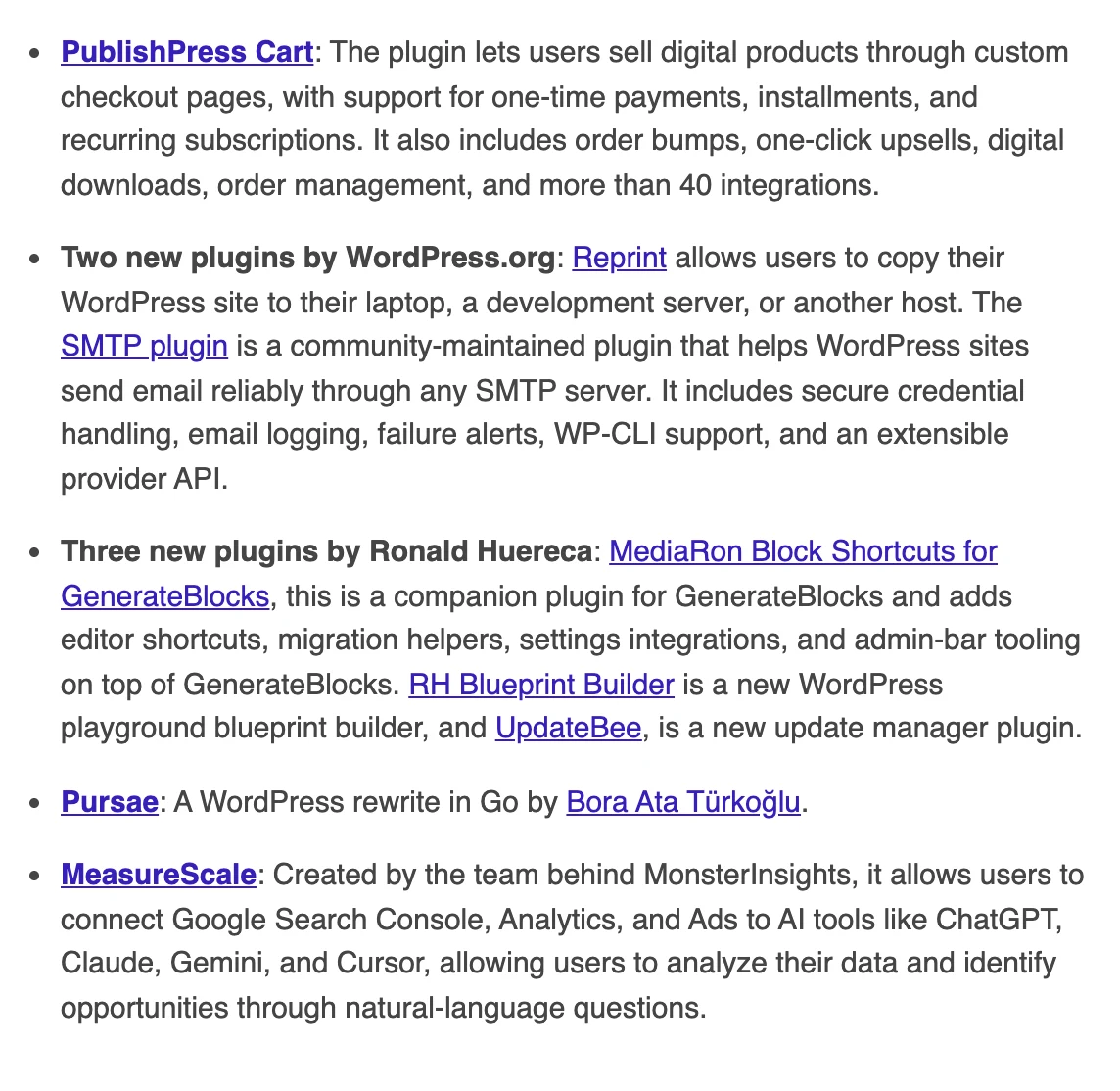
A week later WP-CONTENT.CO included Pursae in issue #297 of The WP Week, their weekly WordPress newsletter, under New Projects.
What changes with WordPress in Go
Open the Pursae admin and it looks like WordPress, because it is the WordPress admin, markup and CSS 1:1. The old .php URLs still work. The differences are underneath.
| WordPress | Pursae | |
|---|---|---|
| Runtime | PHP, PHP-FPM, a web server, extensions | One Go binary |
| Database | MySQL or MariaDB | PostgreSQL 17 |
| Plugins | PHP with full access to the server | Go compiled to signed WebAssembly, sandboxed, with explicit permissions |
| Themes | PHP templates | Go templates and a theme.json manifest, no code in the package |
| Cache, SEO, security, languages, store | Separate plugins | 18 plugins built in, off until you switch them on |
| Updates | Core, plugins and themes each on their own | One click, every binary signed |
What a WordPress site really costs
Most WordPress sites don't get into trouble because of WordPress itself. They get into trouble because of everything bolted onto it.
Take data leaks. A lot of the ones you read about follow the same pattern on PHP and MySQL sites. A form that doesn't check what people type into it, a plugin that talks to the database the wrong way, a PHP version nobody updated in years. One of those is enough for someone to walk out with your customers' emails and passwords. The more moving parts a site has, the more places this can happen.
Plugins are where most of that risk lives. Security reports have said the same thing for years: the large majority of WordPress vulnerabilities are found in plugins, not in WordPress. A typical site runs twenty or more of them, each written by a different team and updated on its own schedule. Every week brings a new list of plugins that need an urgent update.
Many of those plugins also cost money. Caching, SEO, forms, backups, security, translations, page builders. The good versions are usually yearly subscriptions, often priced per site. For a small business it's easy to end up paying more for plugins than for hosting. Run five sites and you pay it five times.
Pursae ships what those plugins do as part of the product. Cache, SEO, security, forms, languages, backups and a store are built in, with no extra licenses and one update for all of them. When you do add a plugin, it runs in its own sealed box and can only touch what you allowed.
WordPress in Go is one binary, not a stack
Running WordPress well means running PHP, PHP-FPM, nginx or Apache, MySQL and cron, and then a caching plugin and a security plugin on top. Each piece has its own config file and its own update cycle.
Pursae is a single static binary. The admin, both editors and the bundled themes are embedded in it. Point it at PostgreSQL, put a TLS proxy in front, and that is the whole setup. Database migrations run when it starts.
Plugins that can't take the site down
This is the part I care about most. A WordPress plugin is PHP running with the same rights as WordPress itself. It can read every table, call any URL and write anywhere on disk. One bad update and the whole site is gone.
In Pursae a plugin is Go compiled to WebAssembly and runs inside wazero. It only gets what it asks for, like read access to the database or network access, and a site installs a package only if it can verify the signature.
WordPress in Go, by the numbers
Same content (1,000 posts, 200 products), the Twenty Twenty-Five theme and the same container limits. WordPress 7.1.4 on PHP 8.3 with OPcache against Pursae 0.1.9, on an Apple M2 Pro under Docker.
| WordPress | Pursae | |
|---|---|---|
| Single post, no page cache | 58 req/s | 394 req/s |
| Single post with the usual plugins* | 19 req/s | 232 req/s |
| DB queries on the home page, same plugins | 139 | 16 |
| Idle memory, whole stack | 233 MiB | 95 MiB |
*WooCommerce, Yoast, Polylang, ACF, Elementor and Contact Form 7 on WordPress, the built-in equivalents on Pursae.
Cached pages are a tie. WP Super Cache with nginx is about as fast as Pursae Cache, and cold start is the same. The gap opens when a request actually has to run code. The method and every config are in the benchmarks doc.
Many sites on one server
If you run more than one site, the savings add up quickly. With WordPress every site needs its own share of PHP and MySQL, and each one holds memory even when nobody is visiting. Pursae is one small program. The same file runs every site on the server, and each site sits at about 95 MB of memory when idle, where the WordPress setup above sits at about 233 MB.
In plain terms, the same server holds roughly two and a half times as many sites. That means fewer servers and a smaller monthly bill. You also never have to keep different PHP versions in sync across your sites, because there is no PHP to keep in sync.
There is a bigger win further down the road. Today each site runs its own copy of Pursae. If a future version lets one running core serve many sites at once, those sites would share the memory the program itself needs and each would only pay for its own content. That isn't in the code yet, but for agencies and hosting companies with dozens of small sites it is the direction that saves the most.
What it doesn't do yet
PHP plugins and PHP themes don't run on Pursae, and there is no WordPress-style multisite network. Each site is its own install. Moving over works through the standard WXR export. Posts, pages, terms, comments, menus and media come across, and products move with the WooCommerce CSV. Passwords and settings stay behind.
So if your site depends on a dozen premium plugins, this isn't a weekend switch. It fits new sites best, and sites where the built-in plugins already cover what those plugins did.
Why I say PHP is done
PHP isn't disappearing tomorrow, and WordPress still powers a huge part of the web. My point is that the reason WordPress chose PHP in 2003 no longer holds. Back then cheap shared hosting with mod_php was the only way to reach everyone. Today a single binary in a container is easier to run than a LAMP stack, faster, and safer to extend. I wrote separately about when a PHP application should move to Go.
Matt said Go in 2013. Pursae is what WordPress in Go looks like in practice. This site runs on it too. The code is on GitHub. Try it, open an issue, and leave a star if you like where it's heading.